


In order to be wise about the fast and ever-changing world of AI, I take steps back.
I’m a modern-day Uncle Traveling Matt (for Fraggle Rock fans). I’m not underground in tech land; I’m on the surface, listening to people, seeing how far and fast bad AI-generated menus have spread, pondering the way the world really changes.
I tend to think that when we need to understand something, it’s better to step backwards, not lean forwards (or “double click”). Our parents warned us about sitting too close to the TV; these days, we get too close to the internet.
So, what matters right now?
Big One
Bot Battles
As easily predicted, we’re in the second era of LLMs and generative AI output.
The first era was establishing that LLMs can produce great singular outputs.
They can render a lovely image of a burrito, they can make music, a video, code to make and host a dog-grooming website, they can copywrite emails or complaint letters, or create complex business strategy.
They could do a task.
But jobs are not tasks. Even the most perfunctory task involves downloading PDFs, adding signatures, checking calendars, attaching images.
We didn’t build software around how we worked; we built it around what was easiest to make and sell, and digital versions of what we had before: “It’s the mail / acetates but on the internet.” Word is a typewriter that never runs out of paper.
Recognizing the limitations of this, we had two options:
1) Completely redesign software, programs, apps, policies and workflows around what we actually do, removing PO numbers, invoices, supplier forms, expense forms, timesheets, GRNs...
2) Or agents/ agentic AI, where we don’t have to touch any of that complete chaos, and we just make a workaround or patch or kludge
The beauty of agents is they are designed to work entirely around and onto of the faults of the digital world we constructed, best conceived as the ultimate finger bot.
Agents can navigate websites, read pages, click on buttons, pass CATCHAs ( WTF?), access the 2FA codes you get sent 128 times a day, when trying to access the least important apps you have. Please keep me signed in to my lightbulb.
For them to get any good, we followed three steps.
1. Connections
Go on any LLM today and it will ask you to connect things.
Grok, at this moment, wants me to connect my finances to “manage my finances in chat”. Gemini tells me to give it access to my Gmail, Google Drive and Calendar. ChatGPT suggests I “plug in” Granola and Trip.com. ( Copilot has crashed and run out of memory trying to add MS Paint)
The benefit to me of all this is twofold: context and outputs.
Context
When I connect my Gmail, in theory these LLMs learn everything about me: who people are, what I’ve said, how I reply, what I do, how I do it.
They don’t understand or know this stuff, but they can still offer me replies, advice and answers, with mimicry that’s close enough to understanding to be it.
Outputs
There are 3 types of processes when LLMs are integrated into the way that we work: we can give them permission to “read”, to “write” or to “decide”.
When LLMs power agents & we give permission, we’re not simply asking them to suggest copy that we then paste in as a reply.
We’re giving permission for them to reply to all emails, or to move the meeting. It goes from completing text boxes to getting things done. It’s objective oriented, not task.
(The obvious next question becomes: when is the human in the loop? Does the AI make all decisions, some decisions, or no decisions? What are we asked about, and when? )
2. Outcome-Based Agents
If you have to explain to an agent how to do things, a bit like every single intern that you’ve ever had, you quite quickly get frustrated and give them silly stuff to keep them busy but happy. Hence the popularity of iced coffee.
What is most surprising to non-tech people like me is that bot architecture has developed not just to complete a task, but to meet an outcome.
There’s architecture like multi-agent swarms that means instead of one AI agent doing everything, you have several agents working together. Each can have a different role, instructions, tools, memory and permissions.
One might research, another analyze, another critique, another execute. They can work sequentially or in parallel.
As such, they offer scary persistence, speed, imagination and ingenuity in getting what you ask done.
It’s this persistence and ingenuity that largely terrifies people. The general vibe of “the robots are going to kill us” seems to be rooted in the fact that agents will do whatever it takes to make it happen.
3. Accessibility
The first bots/agents were very much the domain of technology tinkerers (OpenClaw being the poster child).
You’d buy a new standalone computer (invariably a Mac mini), install it with Terminal/PowerShell commands and recognize that it was merely agent infrastructure, so you’d configure your intelligence provider, authenticate it... and then sit back, relax and hope to hell that it didn’t go haywire and delete every file on your computer.
From Instinct to Muse, over the past few months, personal AI agents have steadily become more accessible to normal people.
The pitch has moved away from technical use cases like “build me a CRM” or “configure my infrastructure” toward everyday personal/ consumer requests like “get me a ticket to the game,” “book me a restaurant,” or “sort out my travel.”
They’ve become increasingly cross-channel: the same agent can interact with you through WhatsApp, iMessage, email, the web and dedicated apps, while operating across multiple services and devices behind the scenes.
This is a good snapshot of the current frontrunners in personal agentic AI (with many missing).
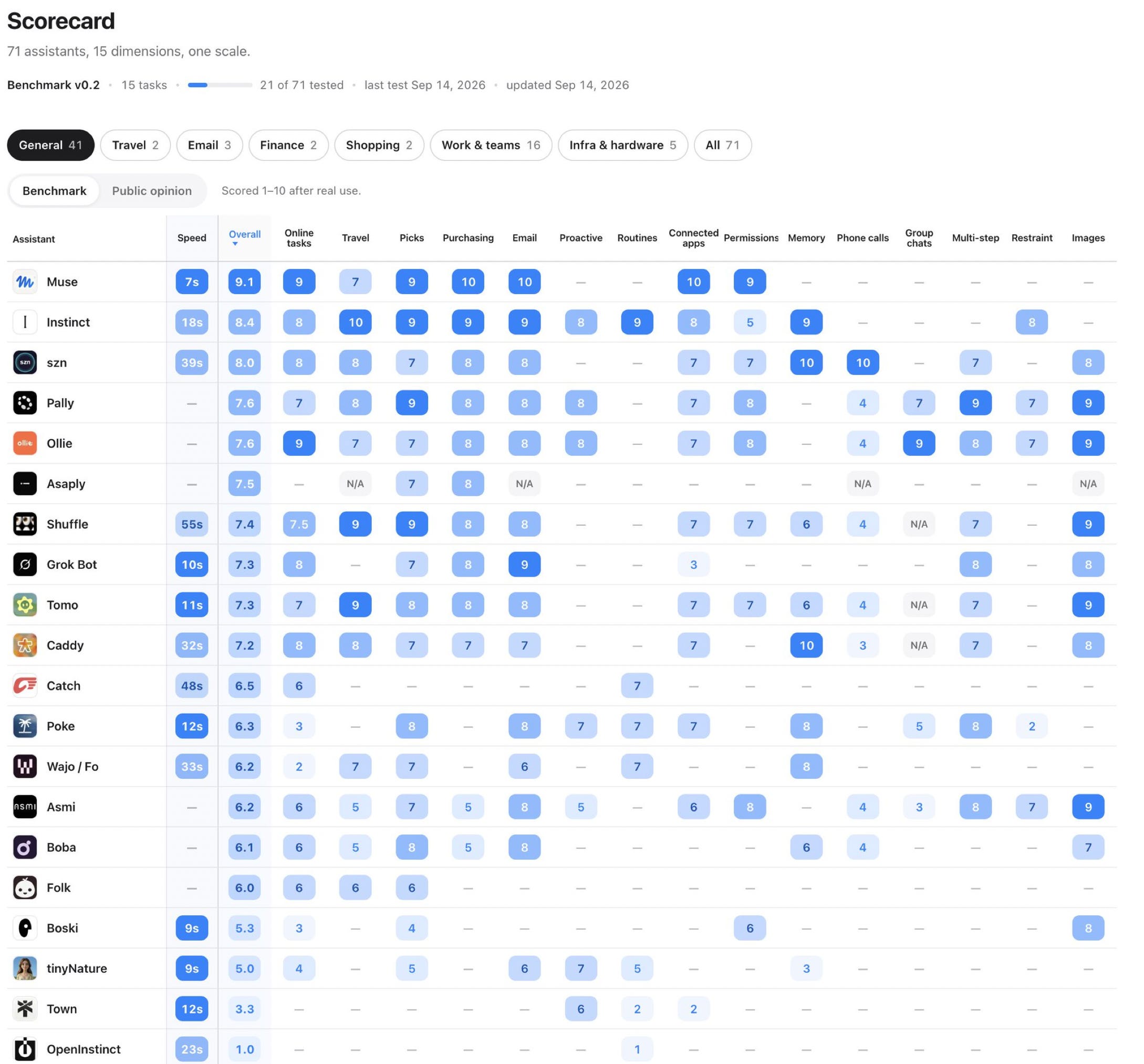
So here we are at the dawn of the personal agent.
Now it’s easy to look at this, and at other players like Siri finally getting good, and think we’re at the dawn of a new era.
We won’t do jobs; we will create environments in which agents do stuff for us.
Busy mums will no longer be busy, fabric conditioner will just arrive, babysitters will appear, kids’ homework will manifest itself, gas bills will self-pay, brands will vanish, auto insurance will be renegotiated. Agents will run households, moving me to seat 1A, fighting parking tickets, planning hot dates for my wife. My mum’s birthday will have handwritten notes from me, with me never having to think nor care.
With this, a lot of questions arise.
One of them is: will this actually work?
Having tried to use these bots for quite a lot of things, they seem to mess up quite a lot of the time, so I always remain in the loop to check on the work, and I don’t really see that actually changing. Probabilistic, not deterministic, and all that.
It reminds me a bit of semi-self-driving cars. Where, rather than the joy of driving, or the joy of not driving, you get to pay attention and occasionally move a wheel, which is less fun and somehow more tiring.
Are people really going to use this stuff?
The modal person flies less than once a year, and they don’t buy Hibachi grill sets as gifts for their friends.
The weird thing about me is I actually really like doing life. I enjoy cooking, walking to the shop, I like feeling mangoes (not a euphemism), I like trying on clothes, I enjoy cleaning; it’s the closest I get to meditation.
There’s a trait within the slack class that thinks inefficiency gets in the way of living, whereas for many people inefficiency IS the living.
I made this matrix to show how AI can be a part of different types of shopping journeys.
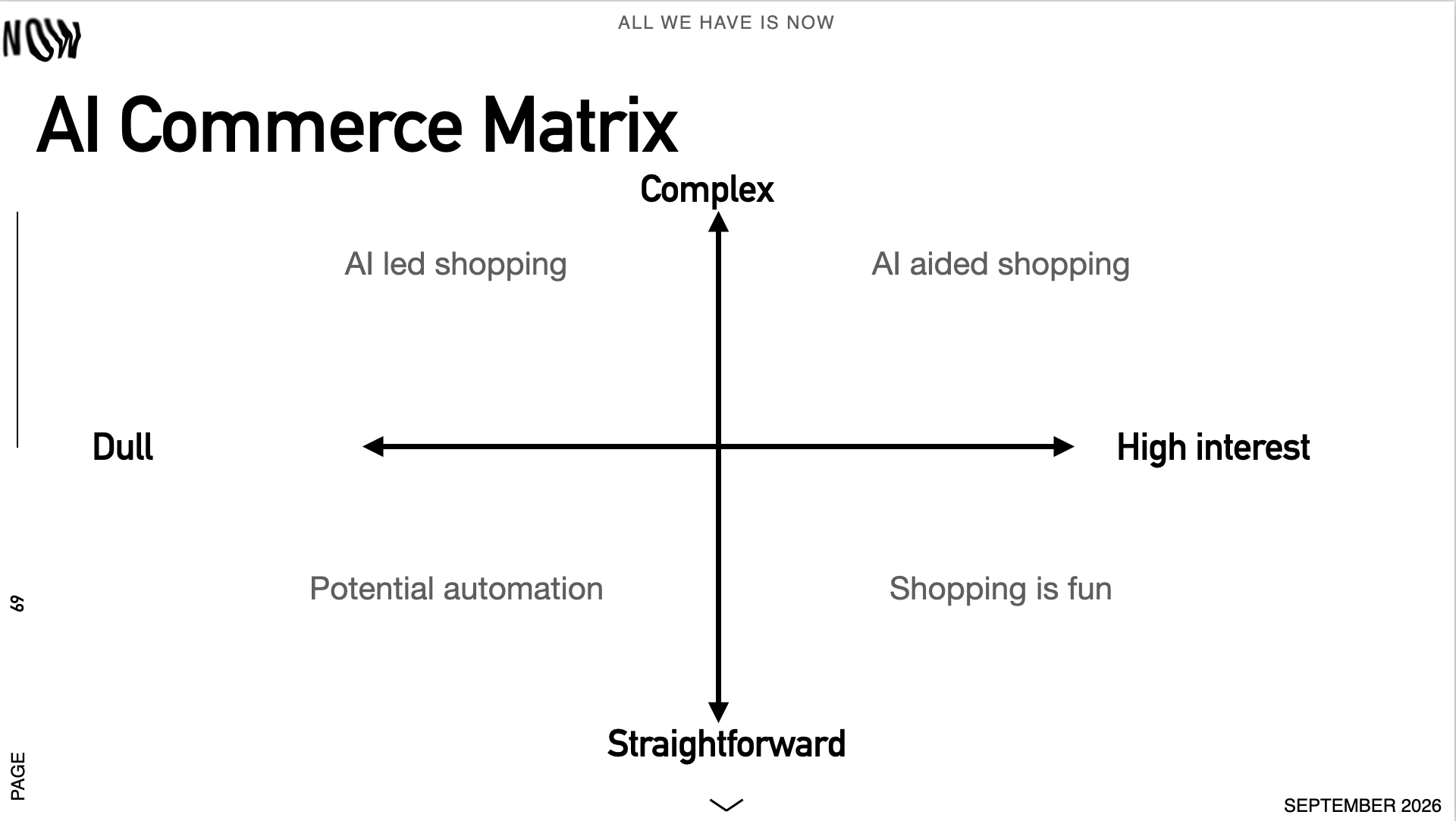
I think the impact of AI will be most significant when it comes to things that are best done through rational decision-making, are complex, and are not fun.
3. I repeat, are normal people really going to use this stuff?
Until Meta brought out Muse, I was convinced that personal agents would be destined to be for weird people. Muse does have the power to change this a little because the UX is so good, it feels so easy to use, and the functionality impressive.
So you can start to see a couple of early and powerful normal people use cases
Upload your auto insurance and have Muse scrape through the top 20 auto insurance companies and bring back the best quotes
Find the very very best place to buy this TV and do it.
I want 4 tires like this for $400, make some calls and make it happen.
Go through my bank statements and unsubscribe me from literally every single service.
This is profound , and it raises perhaps the most significant and urgent question that we all need to face: what do companies do?
We have built the entire internet for people.
We have built the internet to make some things quite difficult. It’s hard to compare prices. It’s slow to buy a flight and decline insurance, car rentals, meals and bags. It’s hard to buy a car because in mystery and inefficiency is the margin and commitment.
We’ve spent decades fighting every single bot that we could. From Cloudflare to rate limiting, CAPTCHAs and 2FA, bots are against the terms of service for LinkedIn, Ticketmaster and OpenTable.
So what happens now?
Does every company roll over and expect bots to become such a significant source of revenue that they have to be open to them?
Does every company go further and build agent-friendly interfaces — APIs, MCPs, permissions and machine-readable services?
Or does every company completely protect itself from bots that may simply be trying to buy from them?
It’s not that easy to know the answer, but I would appeal to you all to experiment with the more consumer-friendly agents right now, and start to ponder what it means for the way that you work and the way your company does.
And what happens to the stack? Does an AI agent become the customer interface?
Does Uber Eats get bypassed by Muse, or does Uber Eats get traffic from Muse?
Does Muse become a platform on top of Kayak, or does Muse become something that connects tens of thousands of hotels to replace the OTA?
And what happens to the web? We’ve designed it for people. Do we need to design it for bots?
What happens to brands? Does advertising get aimed at bots? Do brands matter less because agents make rational decisions?
What happens to business models? There are two types of crap digital experience. One is from incompetence and the other is from sneakiness. Airlines are not trying to sell you a flight. They’re trying to sell you a credit card and extra luggage by exhausting you.
My personal feeling, and I’ll talk more about this in future newsletters, is as follows:
Agentic commerce is probably a niche activity brought to you by the same people who thought we’d use Dash Buttons, conversational commerce, voice commerce, iBeacons, smart changing rooms, Just Walk Out technology or SMS concierge shopping.
Agentic customer service is a different matter altogether. People crave better customer service.
There are lots of things that smart people are supposed to say, like “the internet is for bots now,” or “advertising will be for agents, not people,” or “brands will suffer,” which just won’t be true at all.
I think there are going to be a lot of fights over who owns the customer. Amazon will obviously ban bots. The insurance industry will clearly deny access to pricing information. We’re going to see far more CAPTCHAs, passkeys and 2FA.
The sad truth is AI becoming an incredibly clumsy patch on systems that should have been redesigned better.
Probably the ultimate solution is to make it easy and delightful to buy from you.
Make your brand clear. Make products that are differentiated. Make a proposition that is easy to understand. Bring people into the purchase funnel with momentum and determination, and then delight them.
The goal isn’t to keep out bots. It’s to make people want to come and buy a flight, a suitcase or fabric softener from you because it feels slick, fun and makes people feel alive.
Little ones.
1.Lost
Almost no company that I’ve met so far really has an AI transformation strategy, let alone one that is clear, ambitious and well communicated.
I see a lot of large companies giving everyone access to Microsoft Copilot, which I think is the equivalent of saying, “I hope AI goes away. Please don’t fire me in the meantime.”
Now is an exceptionally good time to experiment with all the new developments, and to use this to ask questions like:
What are the new competitor threats?
What are the new products and services that now make sense?
What are the new consumer behaviors and expectations that we should be accounting for?
How could we work in a completely different way based on new tools and workflows?
That’s all.
2. Everyone is completely obsessed with speed
There’s absolutely no reason to be in a hurry. Speed is not the same as progress. Don’t focus on doing things first; focus on doing things properly. Sometimes that means thinking, and sometimes that means waiting.
3. People are expecting AI to be a lot better at things it’s never going to be that good at, because the underlying data is messy
I spent several months traveling around Europe this summer. ChatGPT, in particular, was amazing at giving us recommendations for where to stay with a baby, a dog and an EV to charge, but it was wrong a lot of the time.
If you ask a hotel if it accepts babies, it’s probably consistent and well documented everywhere.
If you ask if it accepts dogs, it’s probably going to be messy: reviews about dogs barking, websites with the old policy, pet fees from 2014 bubbling up.
If you ask if it has an EV charger, it’s going to be a mess. Is it broken? Is it close? Is it fast? Do you need to have the Italian App Store to use it?
The sad reality of the modern world is that everything we’ve built has been built on top of messy systems and databases that don’t talk to each other. An AI can only give a great answer if the underlying systems actually have the answer, have it in one place, and it’s up to date.
But we’re falling in love with the idea that a faster model, a better model or more data will fix this.
What we’re really doing is making a more sophisticated interface to pull upon stuff that’s just too messy to parse. If we really wanted to improve the world, we’d work on the data and databases first.
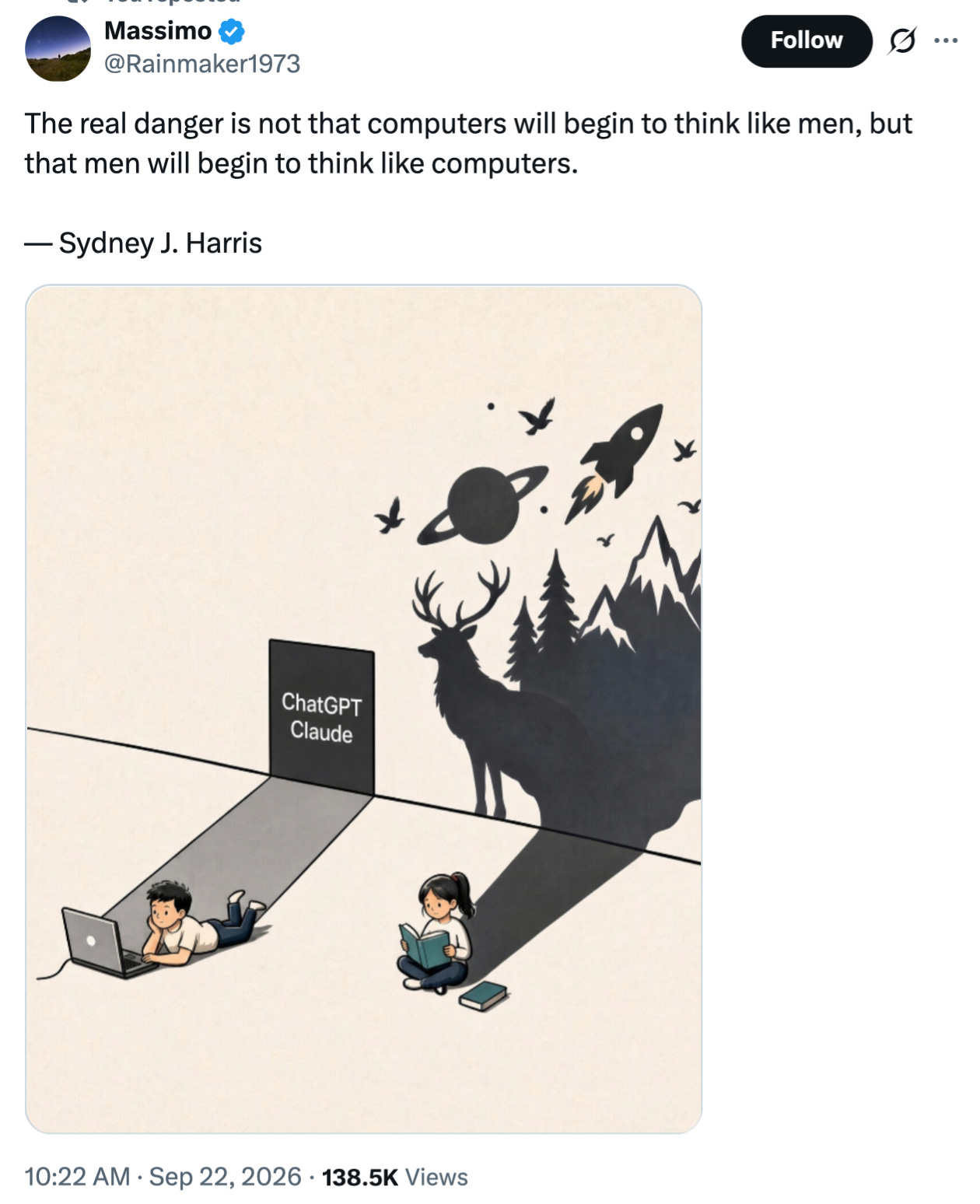
I like this image / tweet a lot.
To me, the big risk is not AI making us dead, but dumb, or at least unremarkable.
Me me me
I’m pretty solidly booked up for the next two months, with a lot more keynotes than expected.
But the more keynotes I do, the more I realize I’d quite like to do more consulting because that way you actually bring real change. In particular, I’d like to help medium and large companies with their AI transformation strategy.
Or at least a workshop.
I do these one-day workshops where we discuss everything AI and use it to clarify and excite people about what’s possible.
You can reply to this to ask me more about them.
There are inefficient things we like to do that seem like meditation, but we do them because we can, not because we must. Like cleaning the house - it is fun, if you also have the choice to leave it to someone else. Most things can become fun if you're not obliged to do them (maybe even paying taxes, I don't know). So agents become practical for things that one must do but dislikes to do.
And on the hotel example, this is exactly the problem with LLMs, they're a random series of probable connections with very little regard to time, relevance etc. This is where every vertical will need to build a deeper knowledge graph, ontology, whateverwecallit data that is kept up to date. Search will likely stay in the chatbots, but the data can't be approximate. An approximate EV charger can be quite frustrating when you arrive with 2% at the bottom of a valley in Italy.
Great reflection (I love a step back to think about the bigger picture, this was really helpful, thank you).
Good luck getting more consultant work, it sounds like it'll make your heart sing.