

Nowism - Edition 36
Some thoughts on the next era of work, and seeing AI in context.

The Big One.
The Third Era of Work
We’ve had two distinct industrial eras. We’re at the start of a third. One that isn’t really about AI, but is fundamentally shaped by it. One less concerned with making people want things, and far more focused on making what people actually want. That distinction sounds small. It isn’t.
Most companies still operate like factories. They’re obsessed with how things get made, with marketing bolted on at the end as an afterthought, never used as the input it should be. Whether you’re making steel or software, services or semiconductors, the mindset is oddly, stubbornly unchanged. Command and control. Hierarchy and process. The org chart of a 12th century army, turbocharged by zoom.
Era One: Execution
The industrial revolution didn’t just change what companies made. It changed what companies needed to be. And the answer was: relentlessly, boringly consistent. The first factories dealt with raw commodities and a few tweaks. Pig iron, Canons, Cotton, Candles and Ceramics were examples.
Scale was everything. Owning assets was everything. Doing the same thing a thousand times, without variation, without creativity sneaking in and ruining the margins, was the entire point. Workers were valued for their compliance. Specialised labour. Standardised processes. Rigid quality control. Henry Ford didn’t want a person; he wanted a biological extension of a wrench.
Technology served as a lever to amplify physical work. Management meant record-keeping and keeping people in line. We wanted to make the same of people, not the most. Bureaucracy wasn’t a dysfunction; it was the way to keep tabs.
It was boring. It was efficient. It built the modern world.
Era Two: Expertise
Markets grew up. And we made more complex things. We turned steel into vehicles, or telephone systems, we unleashed electricity, chemicals, and the power of precision.
Consumer needs got complicated. Companies realised that scale alone wasn’t enough, the question shifted, from “how many can we make?” to “how can we make this better?”.
Expertise became the asset. Companies siloed themselves into deep, narrow verticals of specialised knowledge. Management consultants appeared. KPIs were introduced. Careers had ladders. Training programmes multiplied. “Value-add” became the mantra. And it worked. It works brilliantly. We had cars that would run further than ever, the fridges of our dreams, We put radio sets and TVs into everyone’s hands.
And we never really moved on.
Most companies are still parked in this era, and most don’t realise it.
Most C-suite roles are fundamentally about reducing the cost of goods and limiting legal exposure. Most strategies are built around what competitors are doing rather than what consumers are feeling. Remarkably few companies treat the customer as the primary input into how they operate. Fewer still are genuinely looking ahead.
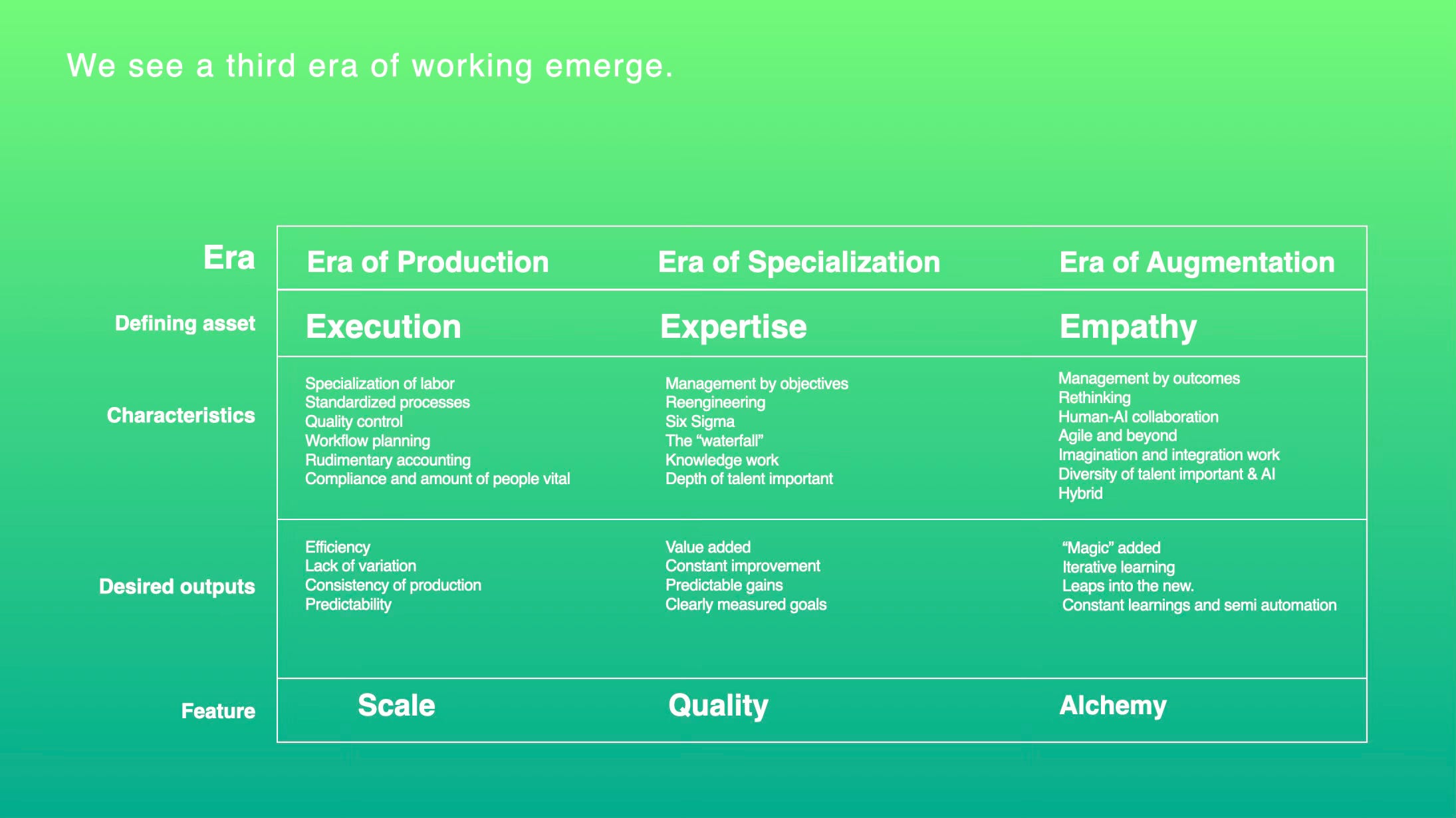
Era Three: Empathy.
Here’s where it gets interesting.
We became so obsessed with optimisation that we forgot to ask whether anyone cared.
We spent billions refining the engineering of a toothbrush, only to discover people just wanted one that looked nice on their bathroom shelf.
We applied waterfall planning to every problem, convinced that if we structured things thoroughly enough, the world would behave accordingly. It rarely did. The world is not a spreadsheet.
Now, expertise itself is being commoditised. When AI can pass the bar exam, diagnose a rare skin condition, write working code, and produce a compelling first draft in seconds, “knowing things” stops being a competitive advantage. It becomes a baseline. Table stakes. There’s only so far that competence at scale can get you. When everything is easy, nothing is easy.
What remains scarce, genuinely and increasingly scarce, is judgment, or taste or breakthrough ideas. When everyone optimizes against the same parameters, You’re in a zero-sum train direct to sameness.
Now enhanced by technology in all directions, We get to deal with a different canvas of opportunity. Armed with the feel for a problem. The ability to sit with a dataset and sense that what customers say they want. The capacity to make the leap that no prompt can make for you.
Management has become about orchestration, about creating an environment in which people can be brilliant. The power structure changes from a function of hierarchy to one of networks.
It’s asymmetric competition, it’s competing on “different” . That’s the skill set that matters now. Not efficiency. Not expertise. The ability to understand what a person feels, and do something useful with it.
For individuals, this is both unsettling and genuinely liberating. If you’re still competing on execution or expertise, you’re fighting a battle that a silicon chip is going to win, and it doesn’t need sleep or a pension. But move into imagination and integration, and the entire job description changes. You’re not a cog. You’re not a specialist. You’re the person who knows which threads to pull, which data to trust, which human truth sits underneath all the noise.
The future doesn’t belong to the diligent, it belongs to those who can dream.
And in this era, we have many questions, What is the role of AI? How do we best structure our firms around it? How do we recruit for these feelings? How do we nurture curiosity? How do ensure that humans do not become lazy. What does leadership look like in this age? What cultures shall we create to embrace the best of both? And most exciting of all, what new things can we make that we’ve never even hoped for?
Commercial Break
I’ve been seeing a lot of AI demo videos, but I find this one the most astonishing to date .
For me, a good AI Agent, isn’t about how much it feels like a person, its what it can do, it’s how it makes people feel.
I’m impressed with the following things here
Empathy - For the first time, I hear an AI that sounds emotionally intelligent and caring.
Helpful - A great customer service agent isn’t one that sounds nice. It’s one that can suggest options — and this does that.
Resolutions - When plugged into the right systems, this agent can take steps to resolve the issue. It’s not merely apologizing, it’s making things happen.
Natural language and vagueness - For the first time, I see an AI system that actually seems to understand the way that real people speak. It can derive meaning from context.
Off-piste - Quite a lot of agents get really confused if you go away from the expected path, but here when asked to speak slowly, it delivers.
Context aware - You can see the agent bring in other unexpected data points to offer holistic solutions (”we can see you’ve been there for 2 nights”) etc.
Of course, questions remain: Will companies trust AI to make decisions? Does AI empathy actually matter? Where are the guardrails?
But this is a real eye-opener — credit to @ElevenLabs. Learn how to build agents like this here.
Little Ones
I’m very interested in how precocious young talent is going to try and change large legacy companies, this reporting was interesting, a change leader who seemed very dismissive of the superficial ways that people use AI. But wasn’t actually able to give ANY evidence deeper change accomplished. Intentions should perhaps not be reported on.
I’m not that obsessed with money, but I’m always interested by what the world seems to value. By the looks of things, it’s all about followers. 60 New Yorkers about what they brought in last year. I think a lot of my European audience will be quite amazed.
I’d never comment on the Middle East Politics nor War tech as it’s far from my expertise, but this piece is key, from afar Drone warfare seems like a classic case of asymmetric disruption, when what dominates is nothing like the old, where entirely new economics and designs emerge. One can’t but help think we’re spending trillions to fight the wars of the 1960’s still .
I wrote about how Algorithmic feeds are kind of ruining things. I’ve spent years curating feeds to follow friends and topics I care about, and social media is a giant car crash. And just because Human nature makes people rubber neck for a snatched second, doesn’t mean we want it, or it’s good for us. How social media stopped being social. And what happens when AI turbocharges it all?
Waymo has come to Miami, it’s now slower in every way and more expensive than any ride hailing app, and while it’s magical, the feeling lasts for merely seconds before it just seems a bit sad and lonely. Self driving cars make a lot more sense when far cheaper, abundance and when the built environment alters around them, a world with limited parking, cars communicating and non ownership. Probably 20 years away.
This nails a feeling many people share: despite all our tech and tools, the built world, buildings, products, streets, even toothbrushes, has converged on a drab, gray, cheaply-made sameness that’s visually exhausting.
What do you do with a perhaps failed attempt to build a vast city in a a line in the desert, pivot to a AI data center, obviously, like NEOM’s the Line.
Inside the weird world of AI dating. Can’t all these people going to a place to talk to AI’s just talk to each other?
My favorite, real life based rebuttal to the quite outlandish much discussed CitriniResearch note came from Twitter
Nobody ever got fired for being boring, Great writing from Thomas Sloane ,
New polling shows people really hate AI, more so that ICE, and every politician, It’s a bit stupid because people can’t really hate the technology, It means 26% of people are hating what we’re doing with it. Lots of people are surprised by this. It seems pretty obvious to me.
Me Me Me
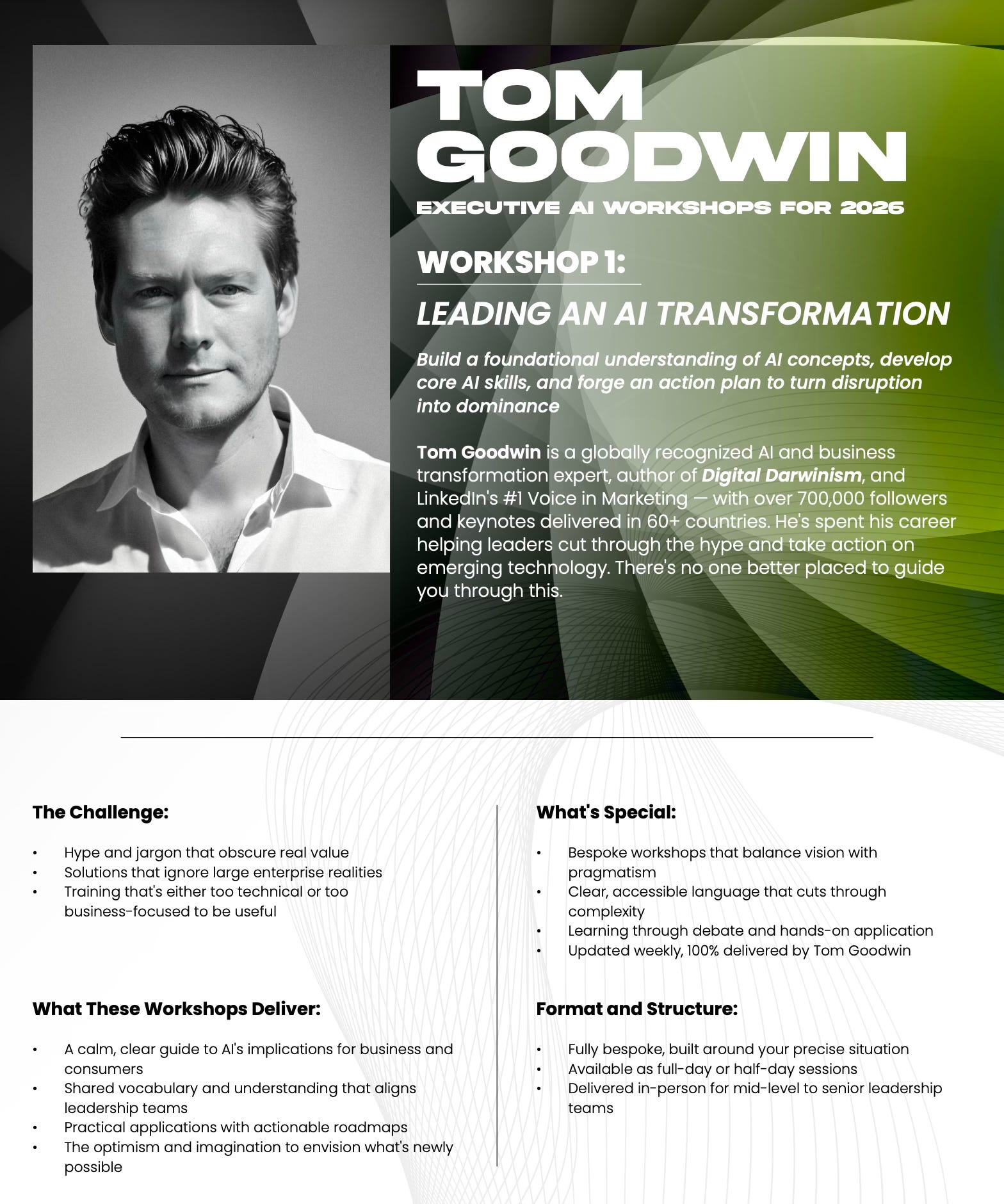
This week, I have mostly been doing my AI workshops. ( I hope you’ve seen the Fast show and Jessies Diets )
Entirely custom-made AI workshops for medium to large businesses.
In person, anywhere in the world, from half days to 2 day long.
Starting from $25,000 USD.
Reply to this email if interested and lets have a chat about what’s ideal and make it together.
Tom, this is good! The industrial revolution didn't just change products. It changed what "company" even meant.
A problem in the West is that we now have too much. Several times a year, we lug a carful of clothes, books, and miscellany to the local charity shop.
There is no longer excitement from acquisition; it is rare now when something delights. Even overseas travel has become mundane from it occurring too often, and I had loved exploring new locales.
I am reduced receiving (gratefully) gift cards for the local high-end restaurant as presents from family. That I still enjoy.
I suppose 'not spending' can be a good thing.